What obstacles can true friendship overcome? And is it difficult to try to see the world differently than through your own eyes? This will be discovered by the first Czech viewers on Monday, December 15, at the pre-premiere of 9 Million Colors at the Světozor Cinema in Prague, followed by a concert of the chamber sextet Floex Ensemble. The producers of this short film are the holders of the international Emmy Award, Jakub Košťál and Vratislav Šlajer from Bionaut. 9 Million Colors will then enter distribution in spring 2026 and is already on the list of registered films for the Czech Lion in the animated film category. The film was created in co-production with Bionaut Animation, Divize studio, Trollfilm, and Reynard Films. The Czech distributor is Zero Gravity.
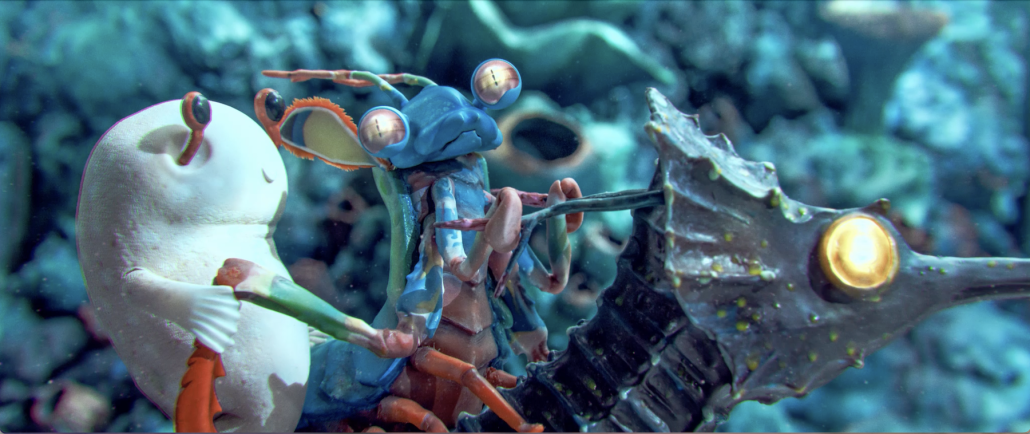
“The film 9 Million Colors is an ode to friendship so strong that it approaches love. It is also about mutual acceptance, which begins with our ability to see differently than through our own eyes. It is for everyone who has ever had someone beside them who could not perceive their world in exactly the same way,” says director Bára Anna Stejskalová. She filmed the movie using classic puppet animation techniques and created more than forty puppets of crabs, shrimp, jellyfish, fish, dolphins, turtles, and a seahorse. To create the illusion of an underwater world, the creators used projectors to simulate reflections on the water's surface. The film brings viewers closer to the real scale of vision of the carnivorous shrimp, the peacock mantis shrimp, which has a total of twelve receptors for perceiving colors. This distinguishes it, for example, from sea crabs, which can only see polarized light. The animation work took the creators a total of two years, as they had to animate a large number of limbs of all underwater creatures along with the complexity of depicting swimming movement “underwater.”
Before its first screening, the film traveled a bit around the world, having been selected for the program of several European festivals. Outside of Europe, it managed to win the award for best animation at SapporoShortFest and the sponsors' award at the New Chitose Airport International Animation Festival, both in Japan.
It has also received special jury awards twice, in Los Angeles and Baku. Meanwhile, the creators have accepted invitations to five more European festivals and will also travel to New York. With its original visual language, puppet stop-motion animation, and captivating music by Floex, which orchestrates emotions, rhythms, and underwater sounds in the water, 9 Million Colors has been attracting international attention from the start. The story of two different perspectives on the world is also attractive and current, as we know from the world of people. Unlike the assertive shrimp Fran, who perceives the ocean as a rainbow paradise garden with her special kaleidoscopic eyes, the shy and blind fish Milva sees absolutely nothing due to her handicap. That is until Fran cuts off the eyes of a mocking crab and lends them to Milva. The fish and the shrimp embark on a journey of friendship, trying to share the same world out of mutual love, even though each sees it differently. The immersion into the ocean depths is enhanced by the melodic tones of splashing waves, the clicking of crab pincers, and the moving choreography of underwater creatures.
At the concert following the first public screening in the Czech Republic, the Floex ensemble will present delicate orchestral textures, electronic pulses, underwater silence, and ocean storms. In addition to the music for 9 Million Colors, the chamber sextet of top musicians will play Dvořák's compositions, for which the composer and multi-instrumentalist Jan Šikl contributed sensitive arrangements. Floex's distinctive soundtracks for computer games such as Machinarium, Samorost, or Papetura, as well as rearrangements of tracks from studio albums, will also be on the program. At Světozor, Floex will be accompanied by robotic drummer Josef.
The film 9 Million Colors was created with the support of the State Fund for Audiovisual Culture and with the contribution of the Czech Horizon Grant supported by the PPF Foundation.