Place:
Date:
1/2/2026 - 28/2/2026
Price:
?
Web:
An awareness campaign that has been encouraging individuals, groups, and entire communities to abstain from alcohol for a month since 2013.
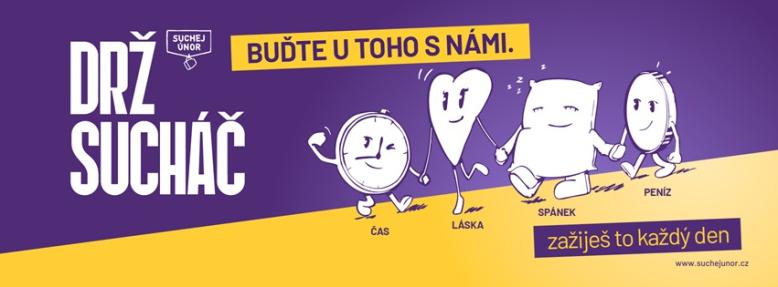
Dry February begins. For the fourteenth time, it invites people to take a month-long break from alcohol and other addictions and to reflect on what alcohol, drugs, or even scrolling on their phones gives them in life and what it takes away. This year's edition focuses on the areas that "Dry February participants" mention most often: TIME, LOVE, SLEEP, and MONEY. Four values that form the symbolic strong quartet of 2026. According to the Alcohol Report in the Czech Republic 2024 published by the National Monitoring Centre for Drugs and Addictions, the Czech Republic has long been among the countries with the highest alcohol consumption in the world. We consume 160 liters of alcoholic beverages per person annually, which corresponds to 9.4 liters of pure alcohol (ethanol) per inhabitant. Approximately 47% of the total amount of ethanol is consumed in beer, 29% in spirits, and 26% in wine (source: Alcohol Report in the Czech Republic 2024). This year, Dry February comes with new interactive content on the website suchejunor.cz, which guides participants day by day through a month without alcohol. It is based on the feelings and opinions of participants from previous years. Dry February will offer one theme or practical tip each day for improving life in the areas of time, relationships, rest, or finances. The organizers go beyond mere abstinence and aim to provide maximum motivation throughout February for those who are interested and willing to reflect on their drinking habits. The campaign is supported by the Ministry of Health of the Czech Republic, the Office of the Government of the Czech Republic, the Institute of Clinical and Experimental Medicine (IKEM), the Addiction Clinic of the 1st Faculty of Medicine, Charles University and VFN (KAD), the National Institute of Mental Health (NUDZ), the organization Podané ruce, and the AquaLife Institute. Dry February is a health awareness campaign that neither moralizes nor prohibits. It opens a discussion about the role of alcohol and other addictions in Czech and Slovak society and offers the opportunity to take a break from alcohol and other addictions for a month. Last year, approximately 1,600,000 Czechs participated in the challenge, which is about 22% of the entire adult population and about 350,000 more than in 2024. A significant portion of them drank less or not at all even after February ended (source: ResSOLUTION Group, 2025). "Alcohol is still perceived as a natural part of life in the Czech Republic, even though we know it is among the proven risk factors for a number of serious diseases, including cancers. I believe it is all the more important to combine prevention with responsible public policy. The state has a responsibility to protect especially children and young people from the influence of alcohol marketing and to support tools that motivate the reduction of excessive consumption," emphasizes Health Minister Adam Vojtěch, adding that this approach aligns with the recommendations of the World Health Organization (WHO), which has long highlighted the importance of limiting the availability and promotion of alcohol.
Four values for a better quality of life
This year's edition of Dry February summarizes the experiences of participants with a simple equation: less alcohol means more life – more time, love, better sleep, and more money.
Value: TIME
A month without alcohol brings participants more energy, fewer lost mornings and evenings, and greater freedom in deciding how to spend their time. This might be the impulse for some to try Dry February for the very first time. On the campaign's website (suchejunor.cz), participants will find additional tips on how to make the most of their newly gained time and enjoy it to the fullest. "Meaningfully used time is one of the greatest benefits of Dry February. When you don't drink, you can go to the pub with friends on Friday and send photos from the mountains on Saturday, as participants describe themselves," adds Petr Freimann, co-founder of Dry February.
Value: LOVE
One of the areas where people feel the change most quickly is relationships. Alcohol affects emotions, communication, and the ability to perceive oneself and others. Experts from addiction practice point out that reducing alcohol often leads to improved partnerships and family relationships and strengthens one's relationship with oneself. "It is known that alcohol, in addition to its negative impacts on users themselves, causes damage to those around them – in families, neighborhoods, and society as a whole. Disrupted and dysfunctional relationships with loved ones are a very common intangible consequence of excessive alcohol consumption. On the other hand, functional relationships are often the main driver of positive changes towards greater control over alcohol use or abstinence," says Doc. MUDr. Viktor Mravčík, Ph.D., an expert consultant at the AquaLife Institute in the field of addiction. Dry February does not call for people to isolate themselves at home for a month and avoid society due to so-called sober shaming. "On the contrary, we want to support restaurant attendance even during the challenge and show that it is completely okay to order a non-alcoholic drink in a venue, the offer of which is also increasing. Drinking should not be a condition for having fun," says Petr Freimann.
Value: SLEEP
People also notice significant changes regarding sleep. "Alcohol has a proven negative impact on sleep quality. Although it may facilitate falling asleep quickly, it simultaneously disrupts sleep phases responsible for its restorative function. The result is sleep that may seem sufficient in terms of duration but is actually of lower quality and more fragmented," explains RNDr. Mgr. Ladislav Kážmér, Ph.D., from the National Institute of Mental Health, adding: "Abstaining from alcohol for a few weeks to a month allows these processes to gradually return to their natural rhythms. In addition to these physiological changes, research studies also suggest that a month of abstinence from alcohol is associated with improvements in subjectively assessed sleep quality. This is subsequently linked to feelings of greater energy, better concentration, and overall better functioning during the day."
Value: MONEY
No less significant is the financial benefit of saved money. A break from alcohol often means immediate financial savings, which are visible after just a few weeks. It also highlights the broader economic impacts of excessive alcohol consumption, which place a long-term burden on the healthcare system. "Excessive alcohol use in the country has negative financial impacts not only on individuals but also on society as a whole," warns Lucia Kiššová, director of the Drug Policy Department of the Office of the Government of the Czech Republic, pointing to the negative balance for the state budget. "The estimated social costs associated with its use exceed 80 billion CZK at current prices, while only about 14 billion CZK is collected in excise tax on alcoholic beverages."
Alcohol in Czech society
Approximately 15-18% of the Czech population consumes alcohol at risky levels (estimated 1.3-1.6 million people), while 6-10% of adults fall into the category of harmful alcohol consumption (i.e., 600-900 thousand people). Data from the last two years suggest that daily alcohol consumption is rising again after a decline observed during the COVID-19 pandemic. According to a survey conducted in 2025 by Behavio for the think tank, nearly a third of people drink at least several times a week, with men (39%) doing so more often than women (18%). The most common associations with alcohol are celebrations (66%), fun (53%), and relaxation from stress (53%). "In international comparisons, our alcohol consumption remains among the highest in Europe. The health impacts of alcohol consumption are significant. Alcohol consumption accounts for up to 11% of the disease burden and up to 10% of all deaths in the European region," adds Lucia Kiššová.
Prof. PhDr. Michal Miovský, Ph.D., from the Addiction Clinic of the 1st Faculty of Medicine, Charles University, describes why even a small change in lifestyle is important and why they support Dry February: "We support Dry February as an accessible preventive challenge that allows people to safely assess the role of alcohol in their lives for a limited time, strengthen their motivation for change, and gain experience with abstinence. At the same time, we provide verified information about the risks of drinking, offer brief interventions, and recommend when professional consultation is appropriate – especially if loss of control, withdrawal symptoms, or drinking serves to regulate stress and emotions arise." Furthermore, Prof. Miovský adds: "In December of last year, we supplemented our contribution with support for screening, including self-testing. The new NPAS portal (www.npas.cz) is intended, among other things, for various health-promoting events, so their organizers have a greater selection of verified tools." Only 39% of respondents in the Health Minister's survey are aware of health risks. Risky behavior and loss of self-control are attributed to alcohol by 36% of people, and only 36% acknowledge the potential for addiction. For 81% of those who see health risks associated with alcohol, one of the main diseases is liver disease, particularly the most severe complication, which is liver cirrhosis. "Alcohol can have harmful effects on almost all organs and can be the cause of more than two hundred diseases. It increases the risk of many cancers and heart diseases. If we focus on the liver, susceptibility to alcohol-related liver damage is significantly influenced by our genetic makeup, so moderate alcohol consumption is certainly appropriate. In the Czech Republic, alcoholic liver disease remains the leading diagnosis among liver diseases, and treatment is simple: do not drink alcohol, and we all have that in our hands," describes Doc. MUDr. Soňa Fraňková, Ph.D., deputy head for clinical hepatology at the Clinic of Hepatogastroenterology, IKEM. The goal of the Dry February awareness campaign is not abstinence but to support a conscious and responsible approach to alcohol.
"Alcohol is a firm part of everyday life for us. That is why it makes sense to stop for a moment and look at how much I drink, eat, take, or scroll, why, and what impact it has on me and those around me. Dry February can be, and for many participants often is, the beginning of an important life change," concludes Petr Freimann.
CONTINUE READING

A night with a legend: Arnold Schwarzenegger! An evening that will not be repeated.
An opportunity to experience an exclusive event like no other in the Czech Republic. Arnold Schwarzenegger in person in Prague, in the elegant setting of the Žofín Palace. Actor and former politician Arnold Schwarzenegger will appear at the event "Night with a Legend" at the Žofín Palace. The June program will include a gala dinner as well as the chance for a personal meeting and photos.


Christian Löffler will present his new album in an intimate setting in Prague.
Christian Löffler is an exceptional producer, musician, and visual artist who will present his new album Until We Meet Again on his European tour. In Prague, he will appear in his more intimate and vulnerable form.

Ambiente in Holešovice Market opens three new establishments.
In Prague's Holešovice Market, in Halls 27 and 28, a branch of the Myšák pastry shop, the Skô restaurant by Slovak chef Tomáš Valkovič, and a new location of the Naše maso butcher shop have opened. The businesses are connected by a shared courtyard where guests can enjoy food throughout the day. The courtyard was designed by AP Atelier, the renowned architect Josef Pleskot, whose team also designed the interiors of Naše maso and Skô in Holešovice. The design of the new Myšák branch was created by Tereza Froňková.

SPARTAFEST announces a new feature: it will welcome fans at the iconic Spartan location – at Letná Plain.
SPARTAFEST will symbolically and physically move to Letenská plain in 2026, a place that has been associated with Sparta, its history, emotions, and community for generations. The new edition of the unique sports and music festival SPARTAFEST will take place here on May 22 and 23, 2026.

FOR OLD MOBILE TO ZOO PRAGUE
Prague Zoo has prepared a special event for schoolchildren during the autumn holidays. Every child under 15 who hands in their old mobile phone for recycling at the main entrance will gain entry to the zoo on Friday, January 30, for just one koruna. The mining of rare metals like niobium and tantalum, which are key for mobile phone production, contributes to the deforestation of Central African rainforests. By recycling them, the pressure on local inhabitants – including pangolins, elephants, and gorillas – is reduced. Additionally, the Prague gorillas will have a special program on Friday.