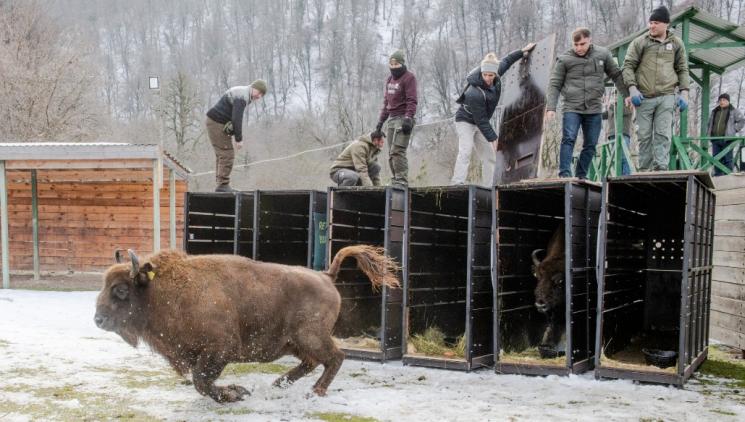

“The cooperation of zoos is irreplaceable. Without it, we would not be able to realize such projects, nor even think of them. I am glad that the Czech Republic has its mark in this international initiative, specifically one from us in Bohemia and one from colleagues in Moravia. In addition to the transport of animals, we are also involved in raising awareness about zoos as key institutions for nature conservation,” says the curator of ungulate breeding at Zoo Prague, Barbora Dobiášová.
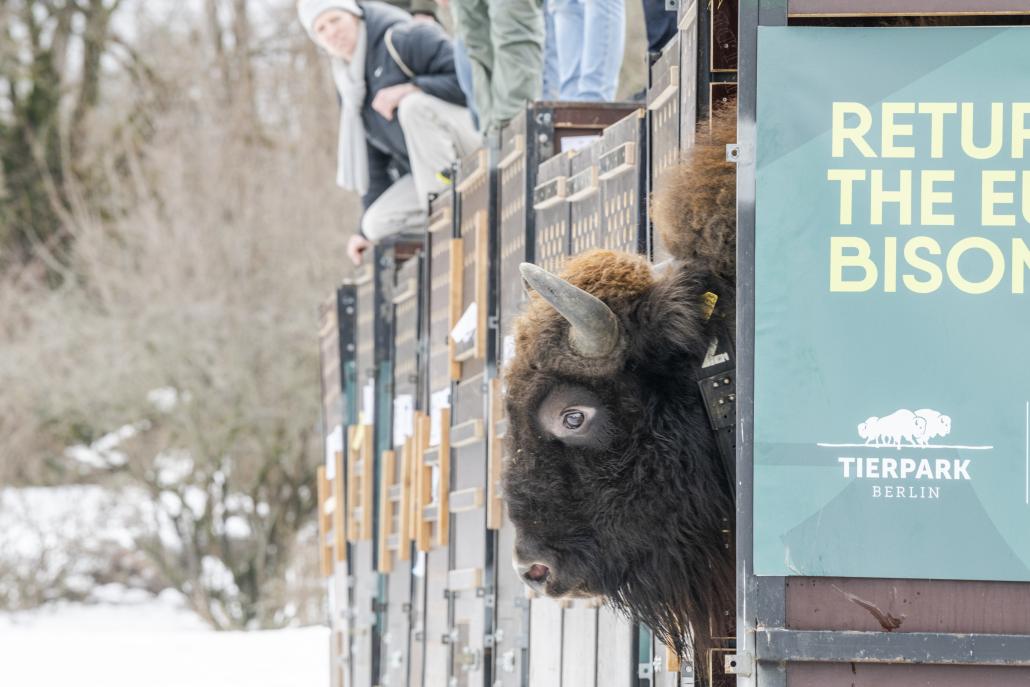
A view of the face of one of the three transported bison. Photo Emil Khalilov, WWF
The selection of specific individuals was overseen by the coordinator of the European Endangered Species Programme (EEP) for European bison, based in Berlin. Factors such as age, health status, and genetic suitability of each candidate played a significant role. The animals were transported to the German metropolis in 2024, where they had the opportunity to acclimatize before the journey. The Berlin zoo then coordinated the air transport from Frankfurt to Baku using a cargo Boeing 777F as well as their ground transport by trucks to Shahdag National Park.
“Every step before such transport requires expertise in veterinary medicine, wildlife management, and logistics, from selecting the animals and conducting medical examinations to preparing and executing the journey itself,” explains Christian Kern, the zoological director of Tierpark Berlin. “We accompany the bison throughout the entire process until they safely arrive at the national park.”
The bison were released into an acclimatization enclosure last Wednesday, where they will now get used to the local conditions. After that, they will head into the wild, specifically to the local vast deciduous forests. Shahdag National Park was established in 2006 and, with 130,000 hectares, is the largest in Azerbaijan and the entire Caucasus. The reintroduction center is located in its eastern tip and was established in 2018.
The following year, the project “Return of the Bison to the Caucasus” began, during which 64 bison have already been transported to Azerbaijan. They have also successfully bred on site. Just last year, nine calves were born there, so there are currently about 90 of these ungulates in Shahdag. The goal of the project is to create a self-sustaining population of bison in their original habitat. The Caucasus was, in fact, the last refuge for bison a hundred years ago.
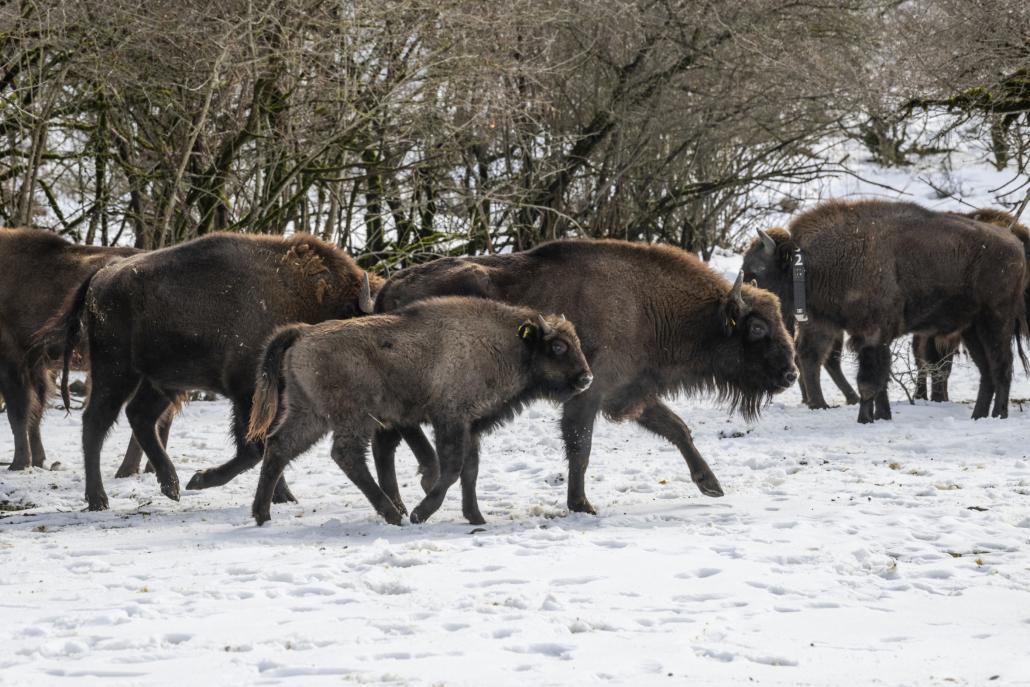
The first steps of the bison herd in the acclimatization enclosure. Photo Emil Khalilov, WWF
“The return of the bison after a century has a special significance for our region. Local communities, schools, and visitors are involved in our work and experience firsthand how ecosystems function and what role endangered species play in them,” explains Zeynab Khalilova, project manager at WWF Azerbaijan.
Bison have survived to this day only thanks to zoological institutions. After they were exterminated in the wild in the first third of the 20th century, European experts established the International Society for the Conservation of the European Bison. Its first achievement was the breeding book of the European bison. At that time, it was the first breeding book for a wild animal species in the world (it is interesting to note that the second one was for Przewalski's horse in 1959). Its first edition published in the 1930s recorded 56 last living individuals. Since then, the bison population has been increasing.
In 1952, bison were released into the Białowieża Forest, and their successful return to nature continued in several European countries. They currently live in ten European states. In total, there are over 2,800 bison in the wild. Several thousand more live in enclosures, fenced pastures, and zoos. On the IUCN Red List of Threatened Species, the European bison currently has a status of “nearly threatened.”
Zoo Prague has been breeding bison since 1948. Since then, over a hundred calves have been born here. In addition to the Troja area, people have also been able to see them in the enclosure in Prague's Dolní Počernice since October. In the past, the Prague zoo has provided bison for reintroduction, not only to strengthen the Caucasian population but also to Bieszczady National Park in Poland.